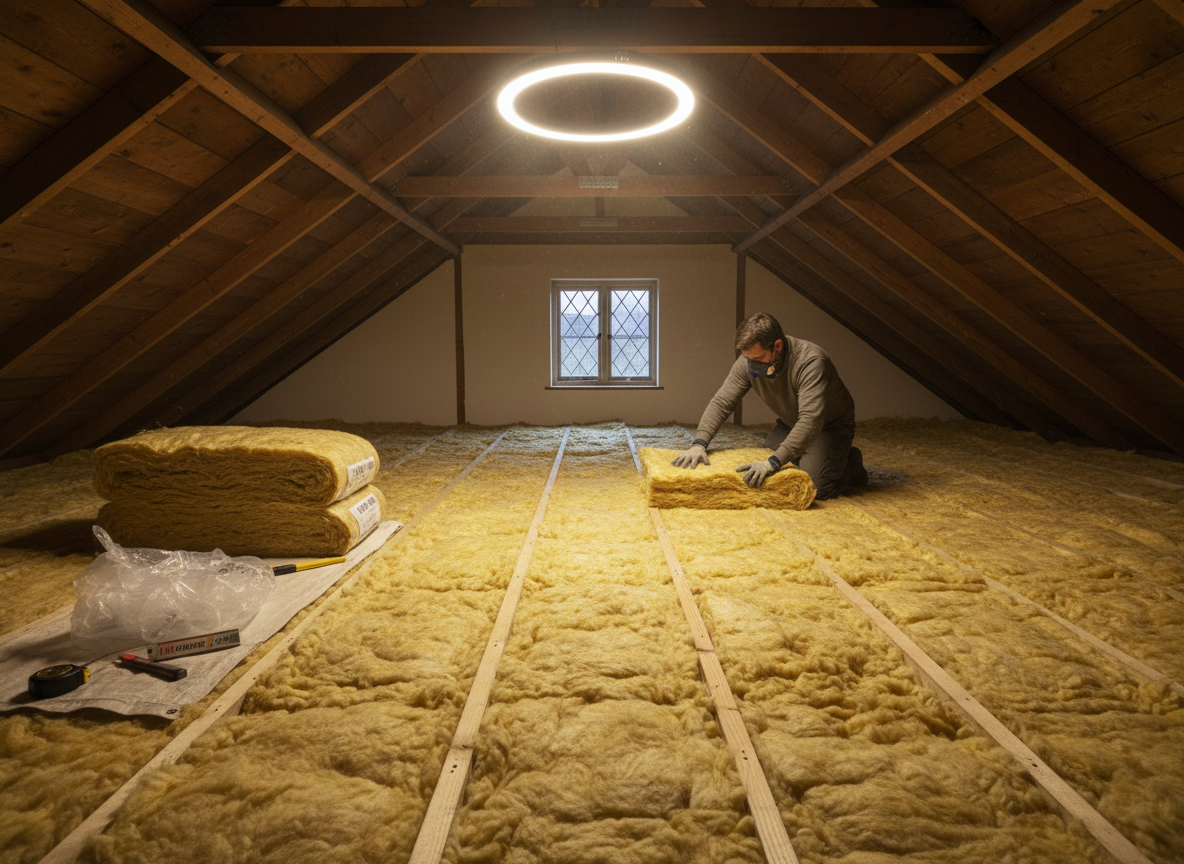
Insulation
Insulation is the first thing we look at. There is little point heating a home that loses that heat through the roof, so before we quote for a boiler, a heat pump or solar, we check what is above your ceiling. Most of our insulation work is loft insulation, and for many homes it is the single most effective measure we install.
Why the Loft Comes First
An uninsulated home loses around a quarter of its heat through the roof. Loft insulation is the most direct way to stop that, it is quick to install, and it lasts around 40 years once it is in — so it keeps working long after the job is done.
It also matters if you are considering a heat pump. Heat pumps work best in homes that hold their heat, so getting the loft right first usually means a smaller, cheaper system that runs more efficiently.
Heat loss and lifespan figures from the Energy Saving Trust, last updated May 2026.
Signs Your Loft Needs Attention
- Rooms that never quite warm up, or cool down quickly once the heating goes off
- Heating bills that feel high for the size of the property
- Insulation you can see sitting level with or below the joists
- Condensation, damp patches or mould on upstairs ceilings
- A loft that has been boarded over old, compressed insulation
- A property built before the 1990s that has never been topped up
What We Install
Current building regulations recommend a minimum depth of 270mm for mineral wool. Most of the lofts we survey are well short of that, either because they were insulated to an older standard or because the material has settled over time.
Full Loft Insulation
Mineral wool laid to 270mm where there is little or no existing insulation. The first layer goes between the joists, the second is cross-laid over the top of them.
Loft Top-Ups
Adding to what is already there to bring it up to current depth. We do not remove sound existing material unless it is contaminated or damp.
Blown Insulation
For lofts that cannot be safely accessed, insulation is blown into the space with specialist equipment rather than laid by hand.
Raised Boarding
If you use the loft for storage, we raise the floor above the insulation and board it, leaving the ventilation gap intact. Boarding straight onto insulation crushes it and undoes most of the benefit.
Loft Hatch and Draughtproofing
An insulated, draughtproofed hatch. Once the loft is colder, an untreated hatch becomes an obvious source of draughts into the landing below.
Pipes and Tanks
Insulating the loft makes the space above it colder, which puts any pipework or water tank at risk of freezing. These are lagged as part of the same visit.
Ventilation Is Part of the Job
This is where insulation work most often goes wrong. Insulating a loft makes the space above it colder, which makes condensation more likely. Without enough airflow, warm moist air from the house gets trapped up there, and over time that leads to damp, mould and rot in the roof timbers.
Every survey we carry out includes a ventilation assessment, and we install additional vents or ventilation trays where they are needed. This is a PAS 2035 requirement, not an optional extra, and we will not insulate a loft that has an unresolved damp problem — the cause has to be fixed first.
Our Process
- A full property assessment and loft survey, including measuring existing depth
- A ventilation and condensation review, carried out to PAS 2035
- A written recommendation setting out what we would install and why
- Installation by trained, TrustMark-accredited installers
- Post-install checks, quality assurance and documentation lodged for your records
- Guidance on what to expect and how to look after the loft afterwards
Cavity Wall Insulation
Alongside our own loft work, we can arrange cavity wall insulation through our partner installers. Cavity wall is suitable for many homes built from the 1920s onwards, where there is a gap between the inner and outer walls that can be filled.
It is assessed separately from your loft, since not every property is suitable — the cavity has to be clear, the walls in good condition and free from damp. If it is worth doing on your home we will tell you, arrange it through a partner who is accredited for that measure, and coordinate it around the rest of the work. If it is not suitable, we will say so.
Cost, Savings and Funding
We would rather be straight with you about savings than quote a headline number that does not hold up. What you save depends almost entirely on what you are starting from.
A loft with no insulation
This is where the gains are real. You are stopping around a quarter of your heat from leaving through the roof, and the difference in how the house feels is usually obvious.
A loft already part-insulated
Topping up from 120mm to 270mm is worth doing, but the Energy Saving Trust puts the saving at around £17 a year in Great Britain. It is a comfort and condition measure more than a bill-cutting one.
For context, the Energy Saving Trust puts typical installation costs in Great Britain at around £750 for a loft going from bare to 270mm, and around £600 for a top-up from 120mm.
Many of the lofts we insulate cost the householder nothing. Loft insulation is covered by ECO4 and by the Welsh Government Nest scheme, and it is often included as part of a wider funded package alongside heating or ventilation work. We will check what you qualify for before quoting anything. Finance is available where a measure is not funded — ask our team for details.
Cost and saving figures from the Energy Saving Trust, last updated May 2026. Figures are for a typical Great Britain property and are not a quotation. Your own saving depends on your property, its current insulation and how you heat it.





